
The Artists behind Creating and Holding Space
- Franchesca Melendez

- Mar 11
- 18 min read
Updated: Mar 12
What does it mean to create space for ourselves — and to hold it?
For the artists in Creating and Holding Space, this question unfolds through deeply personal practices. Each work begins in a different place: curiosity, restlessness, grief, joy, memory, or the quiet urge to understand something that cannot easily be explained. Yet across painting, collage, photography, ceramics, poetry, and mixed media, a shared thread emerges. Making art becomes a way of carving out moments of stillness in the noise of daily life — moments where reflection, emotion, and imagination can breathe.
For many of these artists, the studio becomes more than a place to produce work. It is a refuge, a laboratory, a site of questioning, and sometimes an act of gentle resistance. Within it, they explore identity, community, nature, and the complexities of being human. They revisit memories, translate emotions into form, and allow intuition to guide what cannot be fully planned. Once the work leaves their hands, it opens itself to others, expanding through the interpretations and experiences each viewer brings.
Reading their reflections reveals how varied — and yet how connected — their journeys are. Some speak of freedom and experimentation, others of vulnerability, healing, or the search for clarity. Many reflect on the experience of being women navigating creative and social expectations, and on the importance of protecting the time and inner space needed to create.
Together, their voices form a conversation about what it means to pause, to listen inwardly, and to make something honest from that space. We invite you to dive in and experience their inspirations, their processes, and the ways they continue to create and hold space through their work.

Ana Filipe
“Creating space is an act of survival, and holding it is an act of defiance against the noise.”
Art lives in the tension between order and chaos for Ana Filipe. By profession a software engineer, she is fluent in logic, structure, and problem-solving. Painting, however, offers a counterpoint: a space to explore ambiguity, emotion, and the longing for stillness that refuses definition. In Breathing Space, that contrast becomes visible — the relentless rhythm of modern life set against the quiet sanctuary of a woman’s self-made bubble. Her art becomes both a mirror and refuge, a way to process chaos while crafting something that feels like exhaling.
In Creating and Holding Space, Filipe’s practice is personal and deliberate. In a world that prizes constant productivity, she carves out micro-moments of pause, small acts of survival and subtle defiance. Her figures reclaim societal expectations of resilience and nurturing, transforming them into chosen strenght. She hopes her work bridges the logical and emotional, offering viewers not just beauty, but a moment of peace, calm, and reflection that lingers.
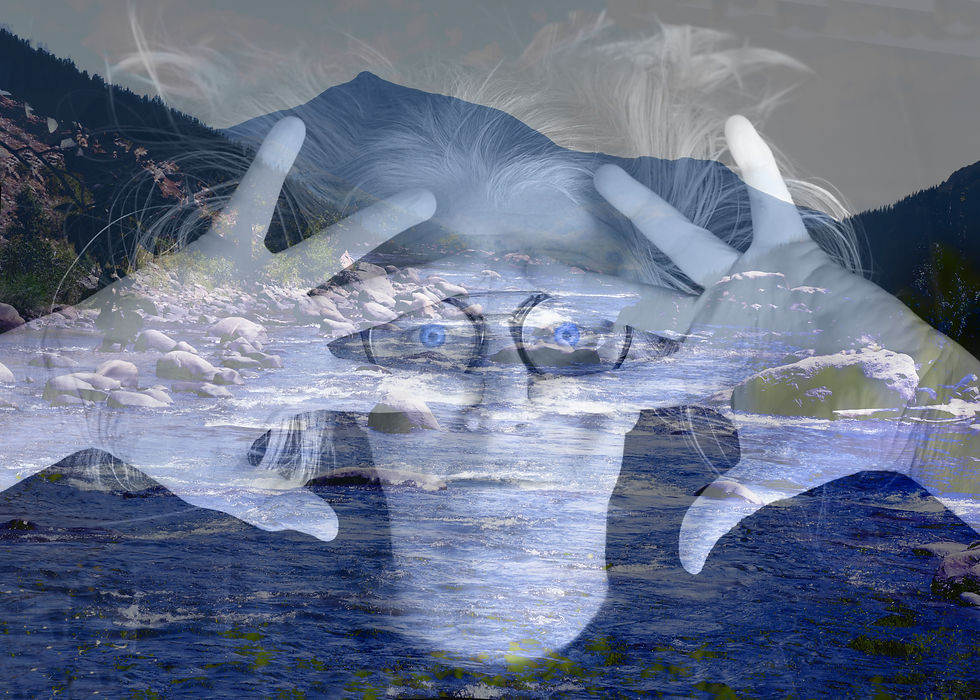
Sarah Kilgallon
“I've always rebelled against most of the "rules" anyway, so as my life goes so goes my art.”
For Sarah Kilgallon, art rises from an inner urgency to express ideas and emotions in a language beyond words. A dialogue shaped by concepts, relationships, humanity. She often returns to a stanza from Ana Nalick’s song Breathe (2 AM): “If I get it all down on paper, it’s no longer inside of me.” Whether through painting, photo essays, or mixed media, Kilgallon creates visual diaries — intimate yet open works that invite viewers to “use them however [they] want to.”
Kilgallon clears mental and physical clutter to make room for what matters: art, music, loved ones, the outdoors. As a woman, she resists imposed limits, recalling the day she heard “You’re a good [basketball] player for a girl,” and replied “No, I’m a good basketball player. Period.” That defiance lives in her work, always testing boundaries, always claiming space.
Katharine Rawdon

“I do what I like, what I need, what I want. I am human, so hopefully my work will resonate with other humans!”
If “freedom” was defined by art, it would be Katharine Rawdon’s. After a career in classical music, shaped by precision and restraint, she turns the equation upside down in her visual practice. Here, playfulness and experimentation take the lead. She chooses subjects intuitively, combines materials without hierarchy, and creates without rules. The studio becomes a space where expression comes first, and structure follows later.
In collaboration with Sarah Kilgallon on House of Our Own, Rawdon reflects a shared commitment to women claiming creative autonomy. Echoing Virginia Woolf’s A Room of One’s Own, she recognizes that women have long held space for others and must now insist on holding it for themselves. Moving through the world as a woman, she notes, is like a bird moving through air: invisible yet constant. That quiet presence hums beneath her work, shaping art that seeks beauty, audacity, emotional depth, and healing.
Marta López

“I want [my art] to claim the moment I'm living through: who I am, what's happening in the world, what it means to be a woman now.”
What do I see? How do I feel? These are some of the questions that flood Marta López’s mind when creating. In her process, art begins with the hand — with technique, curiosity, and a living dialogue between mind and material. Painting becomes a way of understanding what she sees and how she sees it. The act of making is internal and physical, and once a work leaves her studio, interpretation belongs equally to those who encounter it. Control over meaning in unnecessary; the process itself is enough.
In Creating and Holding Space, her portrait of of Yaya Babila is a deliberate act of recognition. To paint her is to grant presence, to hold space for a woman whose gaze carries history and tradition. Conscious of John Berger’s observations on women seeing themselves being seen, and of Laura Mulvey’s concept of the male gaze, López paints women as subjects, not objects, creating art that testifies to time, politics, and the complexity of being a woman today.
Tiz Leão

“[My work] only exists because of my experience as a woman; it wouldn't exist otherwise.”
For Tiz Leão, art begins in anguish. What moves her is not what is already visible, but what waits to be revealed — an inner image that demands material form. She paints to give body to what insists from within, trusting that truth emerges from her particular gaze and lived experience. To feel herself fully inside the project is essential; without that authenticity, the work cannot stand.
Leão’s art is driven by freedom which, she believes, depends on protecting intimate boundaries, spaces of solitude that allow inner liberation before it can exist outwardly. Her work is deeply autobiographical, inseparable from her experience as a woman. Emotional depth and sociopolitical awareness intertwine, where intimacy becomes intervention. By protecting personal space, she creates work that resonates beyond it, where vulnerability transforms into collective reflection.

Alexis McCurdy
“My imagination has always tethered me to hope, and I wish to plant similar seeds of solace among my community.“
Alexis McCurdy believes that art is an act of preservation. Nostalgia and grief simmer at the surface of her practice, urging her to make as a way of surviving what might otherwise fade. Through college, she fragments and reassembles imagery into a precise visual language. Each cut, each placement, carries intention. Yet serendipity keeps the work breathing. It is the unexpected encounter, the aesthetic spark of joy, that allows her to transform emotion into something tangible and sustaining.
McCurdy’s work is rooted in community. Raised in a matriarchal family, she witnessed the relentless, often unseen labor of women — their exhaustion, their resilience, their boundless love. Safe spaces among women have steadied her in moments of pain and restored her sense of purpose. Her figures reflect these layered multitudes, often intertwined with nature and the divine. Through her art, she plants seeds of solace and imagination, offering viewers fragments of hope carefully pieced together.
Gloria Dias Bastos

“In holding space for my creativity, I am also holding space for my wellbeing. “
Joy is both spark and sustenance for Gloria Bastos. She paints because it makes her happy — because the act itself restores and energizes her in ways she deeply misses when absent. Her canvases pulse with vibrant colors and rich texture, inviting viewers to step closer, to almost feel the surface. Having spent formative years growing up in Africa, Bastos carries the imprint of vast skies, lush vegetation, and commanding trees into her semi-abstract, contemporary compositions. Nature, in her work, is vitality made visible; color, movement, and life in full expression.
Bastos reflects on the discipline required to protect creative time, especially amid the layered expectations placed on women. Painting becomes refuge and renewal. Influenced by the strong women in her family, her work carries both warmth and resilience. She hopes it will be remembered for its atmosphere of joy, for brightening spaces, lifting spirits, and offering moments of visual pleasure that linger long after the first glance.

Anna Seel
“My art's about capturing the essence of the natural world – primal, raw, and unfiltered.”
For Anna Seel, creativity begins with curiosity and presence. Her practice is rooted in attentiveness to what is arising at the moment. Rather than imposing rigid structure, she follows the energy she senses: the primal, raw pulse of the natural world. Art becomes less about constructing identity and more about witnessing it dissolve, revealing something unfiltered and alive. She sees interpretation as conversation: each viewer’s perception adds to the work, expanding it into a shared dialogue rather than a fixed statement.
Seel’s philosophy unfolds clearly. Life, she believes, is best approached as a menu of choices, a careful curation of time and intention. Works like Travel Guide, with their disorienting layouts, mirror how memory shifts with emotion. In abstract formulas, she creates space not for certainty, but for resonance — inviting viewers to inhabit, reflect, and carry their own stories within the work.
Cristina Hélcias

“Having your work interpreted by others is like tying up a loose end left waiting during the creation process.”
For Cristina Hélcias, any emotion can spark creation. From the most generous to the most petty, each feeling is welcome as fuel. Her true material is the everyday: the subtle frictions, the impressions that pass through a single day. Once inside that fertile mass, she listens closely: which sensation has chosen to speak? Creation becomes an act of return, a reopening of the door through which inspiration first entered.
Hélcias meets interpretation with curiosity. A piece becomes art, she believes, only in the eyes of another, completed and continued with every new gaze. In Creating and Holding Space, this philosophy is a quiet mantra. Protecting time and physical space for creativity is a deliberate act amid life’s urgencies. Her work is inseparable from her lived experience as a woman, and she hopes it will be remembered for its power to move, to whisper to the viewer: you did not feel this alone; we felt it together.
Francesca Faulin

“I believe that good art should open fissures, and that comes often with a certain degree of discomfort.”
Art is an act of reckoning for Francesca Faulin. Driven by grief, loss, and a need to understand, she returns again and again to personal archives, retracing memories from multiple angles. Her goal is not resolution but narrative: a storyline that honors ambiguity and reveals the unknown within it. Working often through alternative photographic processes, she embraces slowness, letting each image unfold in stages — a careful reflection of memory itself.
Faulin’s studio is a site of reclamation. Traits once questioned — emotional intensity, fragmentation, vulnerability — are redefined as strengths. Growing up in the 1980s, speaking up often unsettled others; through her work, she discovered both voice and authority. Echoing Carol Hanisch’s reminder that “the personal is political”, Faulin creates work that invite discomfort, complexity, and reflection, seeking emotional depth above all.
Irene de Vilder

“Being a woman making these vessels means that I may be creating versions of myself, expressions of my state of being.”
For Irene de Vilder, curiosity is the quiet engineer of creation. Each work begins as a vessel, carefully envisioned, yet the material never yields completely to plan. Shapes shift, curves soften, openings evolve. The clay seems to carry its own will, guiding her hands toward something unexpected and often better, more truthful than planned. The process becomes a dialogue between intention and surrender.
Across her body of work, each vessel takes on layered meaning. Their interiors, hidden by the opacity of ceramic and revealed only through chosen apertures, is central. She draws a parallel between these protected interiors and ourselves: we decide how much of our inner world to show. Historically, the pot has echoed the female body, and though not always conscious, this metaphor quietly surfaces in her practice. Her work invites viewers closer while preserving mystery, holding space with both vulnerability and strength.
Jenette “Koki” Foster

“Once the work leaves my studio, it’s no longer just mine.”
Art doesn’t begin with certainty for Jenette “Koki” Foster — it begins with curiosity, with a sheet of paper waiting, with hands willing to explore, and with a mind open to not knowing. Foster rarely approaches the paper with a fixed outcome in mind. Instead, she lets the materials and the act of making guide her work, trusting the meaning will emerge through process. It’s as if her work is discovering itself in real time.
Foster's practice reflects a deep appreciation for solitude and focus, for the physical and emotional space women claim for themselves and offer to one another. Once her work leaves the studio, it no longer belongs only to her — each viewer’s interpretation becomes part of its story. Through it all, Foster gently reminds us of our own innate creativity, and the quiet power of making without fear.
Anna Rolskaya

“There's a spiritual connection between me and what I make, and I'm not sure my paintings carry life once I no longer do.”
On Anna Rolskaya’s hands, art begins with hunger. Not a gentle or polite inspiration, but an almost physical craving for color. Curiosity follows close behind: How am I going to make this work? What will the next painting look like? She does not begin with fixed symbols or clear narratives. Instead, she sees only movement: patches of color shifting and colliding. If viewers find horses, faces, or landscapes within them, she welcomes it with an amusing state of mind. The story, after all, belongs to them.
Rolskaya’s canvases are emotional imprints — records of mood, energy, and interior life on a given day. They hold space without explanation, inviting reflection rather than demanding meaning. Shaped by early encounters with Russian cultural heritage and the masterpieces of Saint Petersburg, she remains in dialogue with tradition, sometimes guided by it, sometimes resisting it, but always returning to color as her truest language.
Ana Mota

“I want my art to be a safe space where people could be whole and listen to themselves.”
Restlessness often becomes the first push behind Ana Mota’s brushstroke. More than a controlled act, painting becomes, for the artist, a space where what has been silenced can finally emerge. Driven by curiosity and an inner tension that is difficult to name, she approaches the canvas as a receptive field where emotions take shape and impulses are transformed into symbols. Rather than guiding interpretation, Mota invites viewers to engage through feeling. The artwork becomes a mirror in which personal experience replaces fixed meaning, allowing symbols to remain open and alive.
This approach reflects a commitment to letting emotions and contradictions exist without forcing resolution. Her experience as a woman is deeply embedded in this language. Symbols such as the womb, the serpent and the spiral emerge as embodied memories, gestures through which instinct and vital power are reclaimed. Each painting is inseparable from a soundscape shaped by the vibration of her own voice, used as a form of prayer or meditation that anchors the work in the body. The result is a visual and sonic environment where vulnerability and strength coexist, inviting the viewer back into a sense of wholeness.
Mitzie Murphy

“Holding space for others parallels the empathy I try to hold in my work.”
When life begins to feel numb or repetitive, Mitzie Murphy turns to poetry to restore clarity and attention. Curiosity leads her to investigate what surrounds her and to slow down the moment before a poem emerges, allowing language to surface with greater awareness. She approaches poetry as a shared space between writer and reader, where meaning unfolds through encounter and interpretation rather than instruction.
Presented within Creating and Holding Space, her writing extends this ethics of room-making: a practice of holding discomfort instead of resolving it too quickly, and of remaining open to what a reader might bring. That openness is shaped by an awareness of the need to be seen and heard, alongside an ongoing effort to distinguish what feels authentically her own from what social expectations place upon expression. Her poems seek emotional honesty and connection, creating a place where feeling can exist without explanation and where recognition can soften the experience of loneliness.
Piera Zürcher
“What fuels my artistic work most is the path to the expansion of consciousness.”
For Piera Zürcher, artistic practice is inseparable from the search for an expansion of consciousness. Art becomes a privileged medium through which the human being can be experienced in its entirety, bringing together matter, emotion, thought and awareness. Rather than directing interpretation, Zürcher allows each viewer to encounter the work in their own way, trusting that meaning emerges through what reaches them personally. Her presence in Creating and Holding Space continues this search for unity between inner experience and visual expression. For Zürcher, there is no separation between life and creation. A deep connection to her femininity naturally enters the work, shaping the sensitivity through which forms and images emerge. In the critical stages of her process, she gives particular attention to the resolution of pictorial space, carefully considering how the composition holds together. What remains is an attempt to reconcile emotional depth with a lucid understanding of pictorial structure.
Francisca Martins

“Being a woman is a strength for me. We carry burdens which are not our own from the cradle.”
Between the amorphous and the crystalline, Francisca Martins develops a visual language shaped by reflection and emotional questioning. Much of her work emerges from the anguish of misinterpreted situations, failures of communication and the later realization of past experiences. Through artistic practice, she revisits these moments, gradually transforming them into gestures of lightness where reconciliation with what once hurt begins to take form. Her work navigates the tension between the formless and the structured, translating these reflections into a visual field. Martins welcomes the interpretations of others as part of the life of the artwork. Once seen, a piece no longer belongs only to its creator but becomes part of the observer’s emotional memory. In this event, her work reinforces the idea that art can hold what language cannot, offering a site for feelings that resist direct speech. Rooted in her experience as a woman, the body appears as a territory where inherited burdens and emotional memories are confronted and released.
Lilli Marlene

“Any emotion felt deeply can become the beginning of a painting.”
In Lili Marlene’s work, art becomes a quiet portal between souls. Inspiration emerges from emotions experienced with depth and nuance, whether they arise from pain, longing, joy or moments of quiet beauty that imagery can sometimes express more clearly than words. A painting begins with the artist but only becomes complete through the eyes of the observer, as meaning unfolds in relation to another person’s inner world. Through partnership and motherhood, Marlene has come to understand love not as fusion, but as the ability to remain present while allowing space for both self and other. Her experience as a woman informs the emotional landscapes she explores, particularly the negotiation between closeness and independence. Her work ultimately insists on a simple idea: softness is not weakness, and attentiveness can be a form of strength.
Orly Shemesh

“My creative process feels like a play between what I feel inside and the rhythms of nature.”
Between inner emotion and the rhythms of nature, Orly Shemesh finds the starting point of her creative process. Her practice grows from the impulse to shape these sensations through the movement of her hands, allowing internal feelings to take visual presence. While working, she remains attentive to the dialogue between the artwork and those who encounter it. Viewers’ interpretations often reveal unexpected dimensions within a piece, extending its meaning beyond the moment of creation. The notion of Creating and Holding Space mirrors what she experiences within the quiet boundaries of her studio, where concentration allows the work to unfold with intimacy and focus. Rooted in a powerful feminine intuition, her artistic language frequently appears through organic and sensual curves that guide the composition. Shemesh seeks an honesty that feels recognizably hers, a direct translation of sensation into visual form.
Raquel Amorim
“What fuels my work is a tension between control and instability.”
Raquel Amorim’s work emerges from a subtle tension between control and instability, rooted in what she describes as the quiet anxiety of existing in a hyper-stimulated present. She is fascinated by the sensation of standing within a space that appears solid yet is constantly shifting. Within this awareness, she becomes attentive to moments of suspension: when light strikes a surface, when an angle defines a threshold, when a structure simultaneously protects and exposes. Even boredom plays a role, not as emptiness but as an existential pause in which perception becomes sharper. Geometry becomes her way of briefly holding that instability still. Interpretation, for Amorim, does not deviate from intention but expands it, as viewers inhabit the spatial structures she constructs with their own perception and memory. As part of Creating and Holding Space, this practice becomes a disciplined resistance to dispersion, building conditions for focus, clarity and presence. Her work reveals how light, structure and perception quietly shape the way we inhabit the present.
Mariana Sampaio

“Art shouldn't just serve to decorate the living room; it should say something more, put its finger on the wounds.”
For Mariana Sampaio, feelings such as anguish, pressure and anger act less as obstacles than as catalysts. Dark emotional states become the starting point of her creative process, turning artistic practice into a space of catharsis and release. Making work becomes a quiet and safe environment where the mind can decompress and where difficult emotions are confronted rather than silenced. Over time, the way others interpret her work has become less central to her concerns. What matters most is the sincerity of expression, the intention behind each gesture, and the emotional process that unfolds during creation. Her participation in this event reflects a broader need to claim space, particularly for women navigating artistic and social environments. Her experience as a woman continues to shape how her work is perceived and presented, raising questions about credibility, opportunity and recognition. Her work insists on critique, provoking thought and resisting the idea of art as mere decoration.
Aleksandra Mitkalova

“The page becomes a space where stories can exist without being simplified.”
Movement and reconstruction shape the foundation of Aleksandra Mitkalova’s artistic practice. Having relocated many times, both within her country and internationally, she approaches drawing as a way of rebuilding belonging and observing how identity shifts through change. Beyond this, her work grows from attentive curiosity and from a deep interest in how people reshape their lives. Interpretation becomes a dialogue that continues the creative process: viewers often articulate emotions she sensed intuitively but could not fully verbalize, expanding the image through their own perception. In Creating and Holding Space, this lived experience of displacement translates into layered compositions, translucent paper and portraiture that gently hold presence without simplifying it. Listening, care and connection guide her practice, especially when approaching stories of adaptation and resilience. If Aleksandra were to appear in a future history book, she would hope to be remembered for the emotional attentiveness of her work and for portraying women who, despite difficult circumstances, quietly rebuilt their lives.
Sofia Silva

“I think of my role as being a vehicle to materialize feelings and ideas.”
Curiosity leads Sofia Silva back to the natural world that fuels her imagination. Nature becomes the ground from which her work grows, bringing with it excitement and attentive observation. Rather than claiming authorship over what she produces, Silva sees herself as a vehicle through which feelings and ideas take form. The experience of the viewer becomes as relevant as the act of making, since meaning unfolds through encounter and perception. For the artist, creative freedom cannot exist without a sense of safety and connection to the place one inhabits. Only within that grounding can ethical and artistic exploration take shape. Growing up within rigid cultural expectations surrounding gender roles also left a lasting mark on her development, shaping an existential tension she continues to examine through her work. Legacy does not concern her. What matters is the present moment and the possibility of sharing experience in a way that moves someone else.
Inês Caldas

“My paintings are full of color because I feel the need to contradict the gray times we are living in.”
Color becomes the language through which Inês Caldas confronts the present moment. Her paintings unfold through vibrant palettes that challenge what she perceives as the grayness of the times we live in, using color not only as a visual tool but also as a symbolic response to the world around her. Within this chromatic intensity, feelings of introspection, rage, power and occasional joy shape the rhythm of her creative process. She accepts the plurality of interpretations her work generates, recognizing that each viewer approaches an image through their own experiences and memories. At the same time, her practice is inseparable from the social realities she inhabits. Daily microaggressions and the difficulty of asserting herself as a woman in intellectual and artistic spaces continue to inform her work. Her paintings seek to invent new visual combinations while insisting on a social and political impact that does not overshadow the artist behind them.
Andreia Domingos

“Through painting, I try to revisit memories and make them eternal.”
A reflective melancholy is the driving force behind her paintings. In her work, Andreia Domingos returns to people and moments from childhood and everyday life, using painting as a way to preserve presence, relationships and fragments of time that might otherwise fade. Although the figures she paints are friends or family members whose stories she knows intimately, that context remains invisible to the viewer. This absence of personal information creates a distance between intention and interpretation, allowing each observer to project their own memories and emotional connections onto the image. For Domingos, painting becomes an act of care where moments, people and relationships are quietly held. Her experience as a woman also informs the sensitivity with which she observes interactions and constructs the spaces within her compositions. Her work seeks recognition for its ability to preserve fragile moments and for the technical rigor through which detail and memory become lasting images.
Lilli Marlit

“Creating is the only way I’ve found to ground and calm that energy.”
For Lilli Marlit, artistic practice begins with restlessness. A wandering mind and strong internal energy drive her to move, observe and absorb the world around her. Walking and paying attention to what unfolds both within and outside herself allows scattered impressions to gradually organize until inspiration begins to surface. Through making, these fragments find form and the intensity that fuels her thoughts settles into something tangible. Marlit does not try to control how others interpret her work. What matters is resonance, even if it arrives through discomfort, disagreement or misunderstanding. In this event, she brings that same sensitivity to the act of creating space, grounding herself while remaining attentive to the emotions and stories of those around her. Her work often draws from narratives of womanhood, shaped by personal experiences as well as those she witnesses in others. Because a significant part of her practice is rooted in urban art, occupying public space also becomes part of this exploration. She wants the work to remain necessary rather than perfect, and distinctive in what it dares to express.
Creating and Holding Space is on exhibit until March 27 at Bohío Creative.


Comments